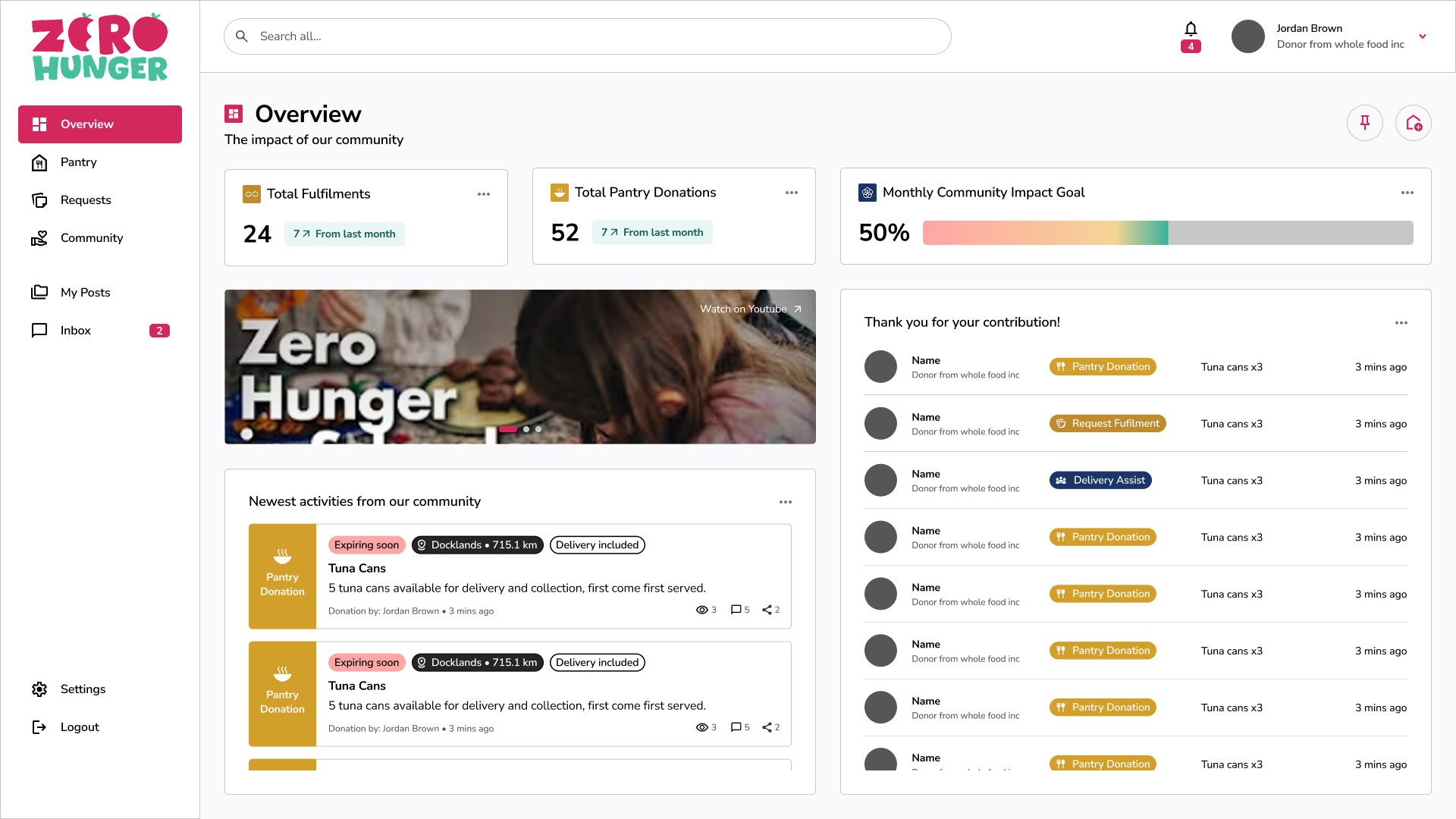
UNAA NSW Zero Hunger Online Platform

A peer-to-peer platform connecting donors, volunteers, and people in need — designed to give and receive help with dignity

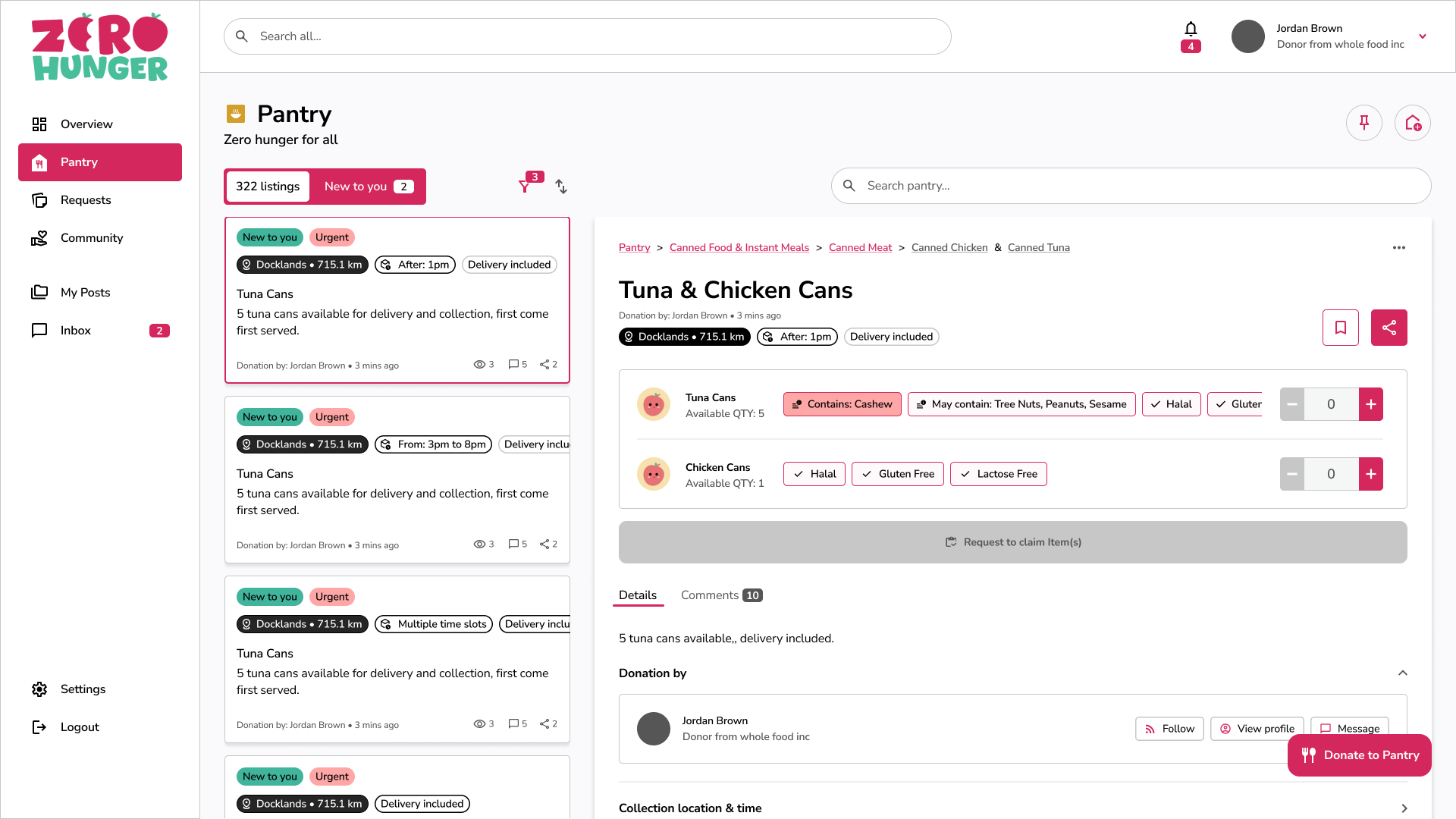
Zero Hunger Online Platform is a peer-to-peer web platform designed for UNAA NSW, connecting donors, volunteers, and people experiencing food insecurity in one accessible space. The platform allows donors to offer food and resources, volunteers to provide assistance, and people in need to access support — all while preserving dignity and reducing the stigma often associated with seeking help.

As the sole designer, I led the end-to-end UX/UI process, from initial research through to final prototype. The biggest challenge was designing for a genuinely diverse user base — spanning ages, tech literacy, and circumstances while ensuring food safety remained non-negotiable throughout every interaction, from listing food to arranging pickup.

The Challenge

Balancing Simplicity, Safety, and Diversity

UNAA NSW needed a platform that could serve three very different user groups — donors, volunteers, and people experiencing food insecurity — within a single, cohesive experience. Each group came with different needs, motivations, and levels of digital confidence, from tech-savvy volunteers to older donors and people in vulnerable circumstances who may be accessing the platform for the first time.

On top of this, food safety couldn't be an afterthought. Every interaction involving food — from a donor listing an item to a volunteer arranging pickup — needed built-in safeguards, without adding friction that would discourage people from using the platform when they needed it most.

Human error added another layer of complexity. With so many people entering information — food details, quantities, pickup times — the design needed to minimise room for mistakes. Rather than offering more options and flexibility, the solution often meant offering less: fewer choices, clearer defaults, and simpler paths, so users couldn't easily get it wrong.

The core design problem: how do you create a platform simple enough to prevent errors, while still making food safety and dignity non-negotiable at every step?
‍

The Approach

Insight-Driven, Not Assumption-Driven

I started with competitor analysis and secondary research, looking closely at tone of voice, visual design, and feature sets across similar platforms — identifying which features were essential to the experience and which added unnecessary complexity. This shaped my direction early on: clear calls to action, straightforward and encouraging wording throughout, and making sure donated food was easily searchable with clear, simple filters.

From there, I built user personas to represent the three core groups — donors, volunteers, and people seeking food — capturing their different needs, motivations, and comfort levels with technology. I mapped out user scenarios and journeys for each persona, identifying key touchpoints, pain points, and moments where the experience needed to feel simple, safe, and reassuring rather than transactional.

These insights directly shaped early design decisions: fewer choices at each step, clear defaults, and guided flows built around real user behaviour rather than assumptions. I then ran usability testing with UNAA NSW staff and volunteers, using their feedback to refine the flows before finalising the prototype.

‍

VIEW PROTOTYPE
Email me at cludia.lam@outlook.comConnect with me on LinkedIn